
GAIN CONTROL, NOT CONTRACTS

When Software Becomes a Consumable Capability...
For thirty years — and more — enterprise technology has followed a remarkably durable formula. Find a requirement. Or don't. Find software. Buy licences. Configure it. Integrate it. Train people. Sign the contract.
Sometimes the contract comes first. Sometimes the requirement is retrofitted to justify it. And sometimes the promised outcome never arrives at all.

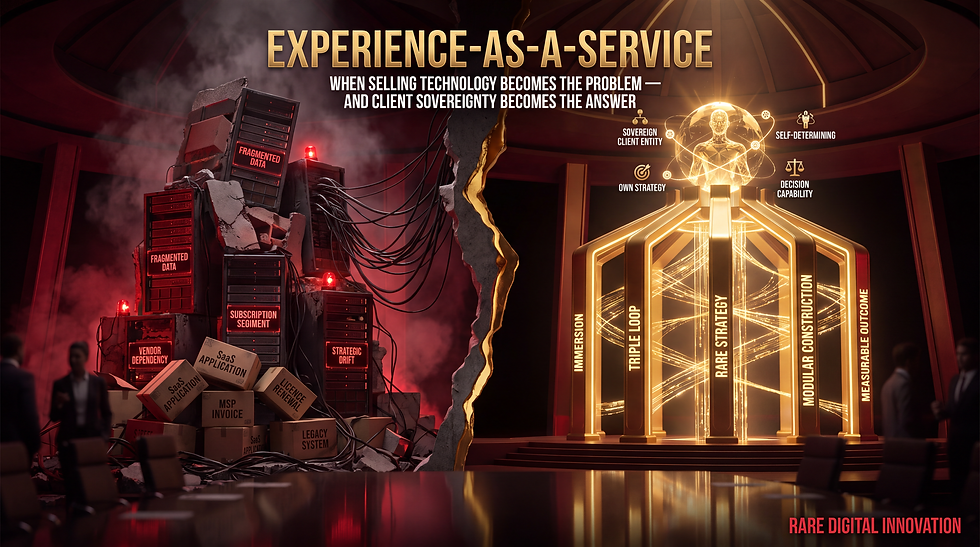
This is the silver-bullet control paradigm perfected by major and minor technology vendors to seduce, capture and control - package capability as an "off the shelf" product, wrap it in licences, integrations and contractual dependency — then progressively make the organisation's ability to operate, adapt and change dependent on the vendor's architecture, roadmap, commercial model and permission. Sound familiar?
More software. More licences. More integration. More dependency. More technical debt. More cost. And, remarkably often: less freedom and certainly less to change.
More software. More integration. More contracts. More technical debt. But not necessarily more capability. For decades, organisations have been told that digital maturity means accumulating technology.
AI is fast exposing a much more uncomfortable possibility-
What if the smartest organisation isn't the one with the best collection of software — but the one that increasingly doesn't need to purchase it from someone?
The $234 billion signal
This is already happening. McKinsey's 2026 State of AI research found 32% of organisations had declined to purchase at least one software product or feature because they could build the capability internally using coding agents.
Gartner estimates US$234 billion of enterprise application software spending could be exposed to "agentic arbitrage" by 2030 — approximately 20% of enterprise SaaS spending.
That doesn't mean SaaS disappears. Far from it. SaaS spending may continue growing for years. What is beginning to disappear is SaaS's historic monopoly over how organisations acquire digital capability.
The numbers reveal the transition: $37 billion of enterprise GenAI expenditure in 2025; 22× growth in two years; $19 billion already flowing into AI applications; AI-native challengers taking 63% of that application market; product-led adoption running nearly four times traditional software; and AI-assisted engineering lifting development productivity by as much as 35–45%.
For said thirty+ years the economic question was largely, "Which software should we buy?" Increasingly, the question becomes, "Which capabilities should we buy instead, compose, automate, generate or build ourselves?"
That is a profoundly different market — because when the cost of creating software collapses, so does part of the scarcity on which software vendors built their control.
The strategic danger isn't that AI eliminates software vendors. It is that organisations remain locked into the seduction of expensive application estates while competitors learn to own the intelligence and dynamically generate the capabilities those applications once monopolised.
That changes the question from - What software should we buy?
to - What direction must we take; what capability should we control to achieve it?
This is much bigger than Generative AI
Generative AI creates.
But combine different forms of AI and something substantially more powerful emerges.
Retrieval AI knows — locating trusted organisational knowledge, records and context.
Predictive AI anticipates — identifying demand, propensity, patterns, anomalies and risk.
Reasoning AI plans — interpreting objectives, evaluating alternatives and determining actions.
Agentic AI acts — invoking tools, APIs and systems to execute multi-step objectives.
Multi-agent AI orchestrates — coordinating specialist agents across analysis, development, testing, security and workflow.
And generative software builds — increasingly creating the interfaces, logic and workflows required around the immediate need.
Working symbiotically- Intent → Intelligence → Reasoning → Agents → Data & Tools → Generated Capability → Guardrails → Consumption
This is no longer simply AI-assisted development. It is the emergence of AI-orchestrated capability.
Ask for the outcome, not the application
Imagine an organisation with trusted enterprise data and governed AI.
Instead of opening five applications and exporting three spreadsheets, somebody asks:
"Identify customers with greater than 70% propensity to disengage, explain why, recommend the intervention and give our team what it needs to act."
Retrieval finds the history.
Predictive AI calculates propensity.
Reasoning determines significance.
Generative AI creates content.
Agents execute authorised processes.
A generated interface presents the capability.
Tomorrow the requirement changes.
So does the Rare capability.
Eventually some software may exist for months, days — potentially minutes.
The model moves from - Requirement → Procurement → Development → Integration → Deployment
towards - Need → Generate → Verify → Consume → Learn → Adapt.
Software starts moving from product to consumption.
Inertia has a balance sheet
This matters because legacy technology isn't expensive simply because of licences.
McKinsey has estimated technical debt can represent 20–40% of the value of an organisation's technology estate, while CIOs have reported technical debt consuming 10–20% of technology budgets intended for new products.
Then add integration, reconciliation, duplicated information, consultants, vendor management, security complexity, change requests, upgrades and workarounds.
And the largest hidden cost - waiting.
Waiting for procurement. Waiting for vendors. Waiting for development. Waiting for integration. Waiting for the roadmap. The real cost of technological inertia isn't simply what technology costs. It is what the organisation cannot do while carrying it.
Control creates freedom
There is a catch.
Stack Overflow found 84% of developers were using or planning to use AI tools, yet only 33% trusted AI accuracy. Around 66% reported frustration with solutions that were "almost right".
Among developers using agents, 87% expressed concern about accuracy and 81% about security and privacy.
AI-generated technical debt remains technical debt.
AI-generated vulnerability remains vulnerability.
Bad architecture generated ten times faster is simply high-velocity chaos.
So the future isn't less architecture.
It is better architecture.
The model moves from - People → Applications → Databases
towards- People → Intelligence → Guardrails → Dynamic Capability → Trusted Data
Underneath sit identity, permissions, APIs, persistent organisational context, cybersecurity, semantic models, audit, assurance and consumption controls.
The organisation determines what AI can: See. Know. Infer. Create. Change. Spend. Execute.
And paradoxically, greater discipline underneath creates greater freedom above it.
RARE - “The future bargaining power of the enterprise sits less in negotiating a better software contract and more in building an architecture that means it can walk away from one.”
Rare Strategy - creating the path out
An organisation cannot leap from fragmented legacy systems to AI-orchestrated capability by buying another AI licence.
If its data is inaccessible, processes undocumented, integrations brittle and suppliers control critical capability, it isn't free to change.
Its historical decisions are already making tomorrow's decisions for it.
Rare Strategy identifies the path out.
Understand strategic intent.
Expose dependency and technical debt.
Establish trusted data.
Create persistent organisational intelligence.
Open capability through controlled APIs and services.
Establish architecture and guardrails.
Then choose deliberately: Retain. Replace. Integrate. Automate. Compose. Generate. Eliminate. That isn't technology housekeeping. It is creating strategic optionality.
Control, not contracts
This isn't the end of enterprise software. It may be the beginning of the end of software determining the boundaries of the enterprise. As applications become composable, interchangeable, interfaces transient and intelligent agents operate across systems, strategic value moves underneath them....the organisation itself - must too....
...Towards data. Intelligence. Architecture. Guardrails. Knowledge.
And ultimately - the ability to change.
For decades, sectors, organisations and leaders accumulated software - sometimes as symbols - yet not gained the outcomes. The opportunity now is to accumulate intelligence, capability, choice and credibility associated with real execution.
The strategic question therefore changes- If we control our data, intelligence, architecture and guardrails — why couldn't we create what we need, when we need it?
That is the pivot - triple-loop strategy fused with executable thinking, practice and technology. That is now. It collapses the distance between human and artificial intelligence, strategic choice and execution — and shifts power from buying capability and not getting it to creating it and doing so. It doesn't move the pieces. It turns the entire board over — and every piece on it.
Rare Strategy. Disciplined digital creates freedom. Control, not contracts.


Comments