
Experience-as-a-Service-When Selling Technology Becomes the Problem
- Rare Crypto

- 11 minutes ago
- 6 min read
There is a cruel irony developing inside modern organisations.
Just as technology becomes exponentially more powerful, cheaper and easier to construct, many organisations are becoming more fragmented, more subscribed, more dependent and less capable of changing themselves.
They are being sold transformation while accumulating complexity and contracts.
Sold productivity while multiplying platforms. Sold intelligence while fragmenting their data. Sold AI while preserving the workflows AI should have made obsolete.
And increasingly, they are buying technologies designed to compensate for problems created by technologies they bought previously.
Welcome to the strange final chapter of the product-and-service era.
AI Is Accelerating. The Enterprise Is Not.
Consider the velocity. Stanford's AI Index found organisational AI usage jumped from 55% in 2023 to 78% in 2024. Global private investment in generative AI reached US$33.9 billion, up 18.7% in a year. Meanwhile, the inference cost of obtaining roughly GPT-3.5-level performance fell more than 280-fold between November 2022 and October 2024. AI hardware costs have been declining around 30% annually while energy efficiency has improved around 40% annually. That is not normal technological change.
It is industrial capability collapsing in price while expanding in power.
Yet McKinsey's 2025 global survey found almost every responding organisation was using AI while nearly two-thirds had still not begun scaling it across the enterprise. Only 39% reported enterprise-level EBIT impact. There lies the danger.
AI adoption can rise spectacularly while organisational intelligence barely moves.
An organisation can therefore become AI-rich and strategically stupid.
More copilots. More agents. More licences. More dashboards. More experiments. More disconnected departmental automation.
Yet still no coherent data architecture, workflow model, AI strategy, operating model or understanding of what should disappear. AI then accelerates the inherited mess.
Organisations Can Now Decompose Faster
Accenture measured a 183% increase in the rate of change affecting businesses between 2019 and 2023, including 33% in 2023 alone. Yet 52% of executives said they were not fully prepared to respond. Accenture's “Reinventors”—organisations building continuous reinvention capability—recorded materially stronger growth performance than peers. The message is uncomfortable.
Standing still is no longer standing still. If competitors improve productivity, remove legacy, redesign workflows and compound organisational intelligence while another organisation merely maintains its inherited environment, the latter does not remain in the same position.
It moves backwards relatively.
The decomposition sequence is brutally predictable: Legacy creates friction.
Friction creates workarounds. Workarounds create SaaS purchases.SaaS creates fragmented data. Fragmentation creates integration. Integration creates support cost.
Support cost creates MSP dependency. Poor visibility creates consultants.
AI arrives and automates pieces of the disorder.
Management sees activity and calls it transformation.
Meanwhile the organisation becomes progressively more expensive to understand, govern and change. Then margin pressure arrives. Investment is constrained.
Better people leave. Competitors move faster. Customer experience diverges.
Strategic options shrink. Assets become impaired. Market relevance transfers elsewhere. Organisational demise rarely announces itself with trumpets.
It arrives disguised as another renewal invoice.
SaaS- The Great Convenience That Learned to Feed
The SaaS era created enormous value. It also perfected a magnificent commercial proposition- remove the friction of getting in, then quietly increase the friction of getting out.
Seats. Minimum terms. Auto-renewals. Tiered functionality. Consumption charges.
Contract uplifts. API restrictions. Data dependencies. Bundled features.
Integration dependencies. Migration costs. Committed spend. True-ups.
Then sprinkle fifty, two hundred or six hundred applications throughout the enterprise and call it agility.
Zylo's 2025 analysis covered more than 40 million SaaS licences and US$40 billion in expenditure. SaaS expenditure averaged US$4,830 per employee, up 21.9% in one year. Organisations were wasting an average US$21 million annually on unused licences. AI-native application spending alone rose 75.2%.
By 2026, Zylo estimated large enterprises were spending an average US$245.5 million on SaaS and wasting more than US$80 million annually on unused licences. It also reported an average of 21 new applications entering large-enterprise environments every month. This is less “software as a service” than software as sediment.
Layer upon layer accumulating until nobody is quite sure what can safely be removed.
Flexera found complete technology-stack visibility actually fell from 47% to 43% year-on-year, while 45% of organisations reported spending more than US$1 million on software audits during the previous three years. Technology intended to simplify organisations is becoming something organisations need specialist technology merely to understand.
Beautiful.
The MSP Faces the Same Reckoning
Managed services are not disappearing.
The traditional managed-service economics are being challenged.
Kaseya's 2026 MSP research found the proportion of MSP customers spending at least US$25,000 annually fell from 75% to 41%. Customers spending below US$25,000 more than doubled as a proportion. Thirty-three percent of MSPs cited slower customer acquisition as constraining growth, while difficulty quickly demonstrating value almost doubled from 10% to 19%. That is the market speaking. Managing more tickets is not enough. Selling another security product is not enough.
Billing another engineering day is not enough.
The question increasingly becomes-
What measurable condition improved?
This matters enormously as AI attacks time-and-materials economics.
If AI reduces 100 hours of analysis to ten, charging for 100 hours becomes difficult to defend. If an agent removes a workflow, preserving the workflow to preserve revenue becomes perverse. If five SaaS applications can be replaced with one modular capability, success should be measured by what disappears.
Enter Experience-as-a-Service
Rare starts from the opposite direction.
Not: What can we sell you?
But: What must this organisation become capable of doing?
That creates an entirely different architecture:
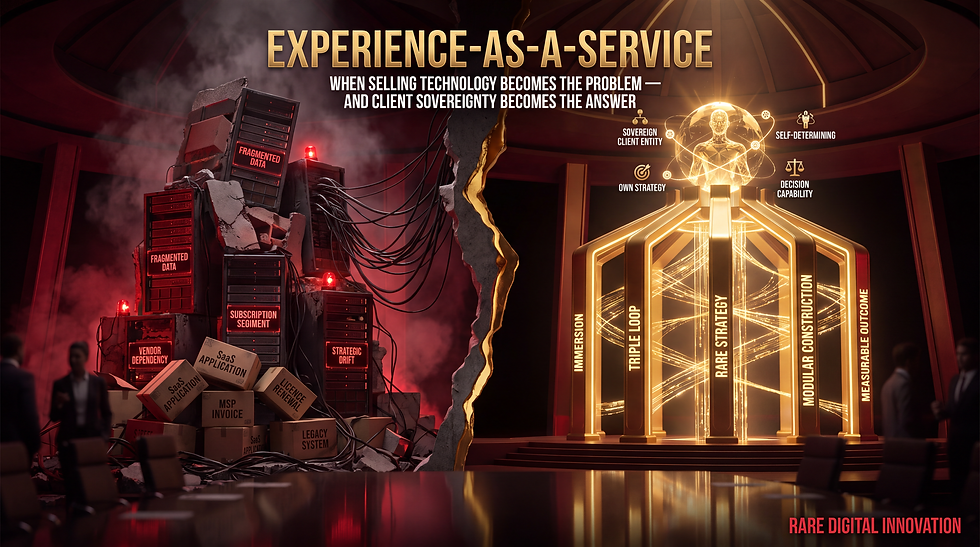
Experience-as-a-Service → Immersion → Triple Loop → Rare Strategy → Rare AI-Intelligence → Modular Construction → Consumption → Measurable Outcome → Greater Client Sovereignty.
Immersion
Rare enters and learns the organisational reality- strategy, people, workflow, systems, data, costs, risk, legacy, vendors and dependencies. No product prescription first. Understand first.
Triple Loop
Then interrogate three levels-
Are we doing this correctly?
Are we doing the right thing?
Should this thing exist at all?
That third question is lethal to traditional technology selling. Sometimes the best solution is not another solution. It is wastage erosion, deletion.
Rare Strategy
The evidence of and for strategic fit becomes direction, prioritisation and strategic control—not another static roadmap destined for SharePoint archaeology.
Rare AI-Intelligence
Data, workflows, organisational knowledge and external intelligence become progressively connected so leadership can understand conditions, contradictions, legacy-dependencies and emerging consequences faster.
Modular Construction
And here AI changes the economics completely. Instead of searching the marketplace automatically for another monolithic SaaS product to add to the legacy stack, increasingly organisations can construct precise applications, agents, workflows, interfaces and automations around themselves. This is Rare's "Model 3"; the software increasingly bends around the organisation.
The organisation no longer needs to bend around the software.
Consumption
Commodity technology becomes consumable. Devices. Infrastructure. Compute. Specialist expertise. Platforms where they genuinely add value. But the client increasingly owns what matters-strategy, knowledge, trusted data, intelligence and decision capability.
Measurable Outcome
Outcome becomes the currency. A 2026 Oxford meta-analysis covering 740 observations from 38 studies across ten service areas found outcome-focused performance contracts were more successful than arrangements centred on processes or outputs, while also emphasising the importance of measurable outcomes, collaboration and shared goals. Did cost decline? Did capability increase? Did legacy disappear? Did risk fall? Did productivity increase? Did strategic freedom improve? Pay attention to consequence—not activity.
Beyond XaaS
This is where the distinction becomes profound. XaaS still largely describes how vendors sell things. Software-as-a-Service. Infrastructure-as-a-Service. Device-as-a-Service. AI-as-a-Service. Different noun. Same commercial grammar.
Experience-as-a-Service describes a mode through which the client progressively constructs itself.
Strategy informs intelligence. Intelligence reveals opportunity. Opportunity determines construction. Construction determines consumption. Consumption produces evidence.
Evidence demonstrates outcomes. Outcomes feed the next strategic loop. The experience itself becomes the service.
There may still be Microsoft. SaaS. Devices. Cloud. Engineers. AI. Security. Partners.
But they are no longer the destination or the feature of the invoice.
They are ingredients.
And that may be the defining economic inversion of the exponential age. Technology becomes cheaper and more disposable. Intelligence becomes more valuable and cumulative. Dependence falls. Capability transfers inward.
The best provider therefore becomes not the organisation capable of selling the customer the most.
It becomes the organisation capable of helping the customer need progressively less selling at all.
Rare's end state is therefore deliberately paradoxical:
the more successful the engagement becomes, the more powerful, intelligent and self-determining the client becomes.
Not captured.
Not skewered into somebody else's product stack.
Not maintained indefinitely inside somebody else's commercial architecture.
Able to construct its own.


Comments