
THE CONSULTING PARADOX

Updated: 19 hours ago
When Selling Becomes the Problem
The consulting industry has become exceptionally good at selling solutions. It needs to become considerably better at establishing whether those solutions are necessary.
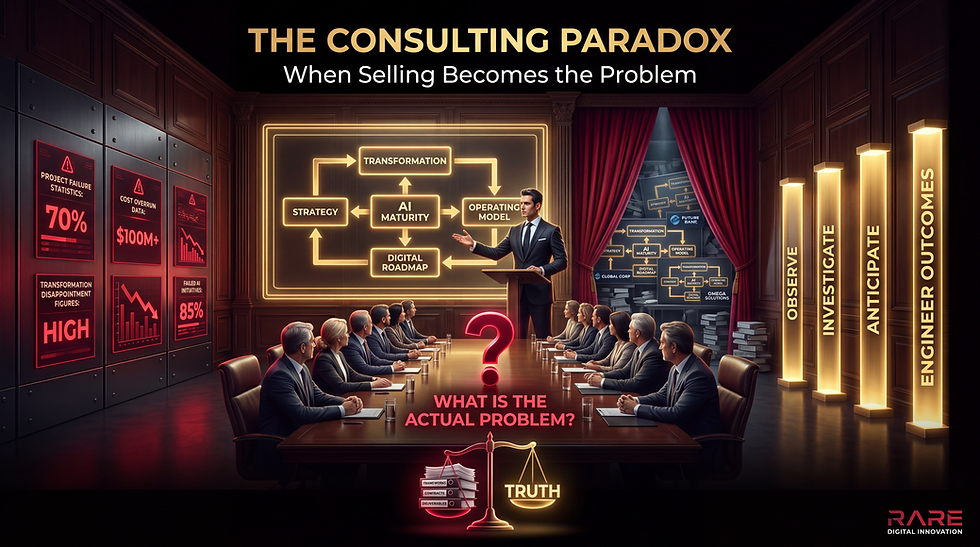
Strategy. Transformation. Restructuring. Technology. Artificial intelligence. Operational excellence. Cost Benefit Analysis. The buzz words and vocabulary changes. The commercial machinery remains familiar.
Identify an opportunity. Establish a consulting or vendor need. Present a framework. Sell the engagement. Develop a business case to create the problem. Deliver the solution. Then sell the next one.
But what happens when the problem being sold against is not the problem the organisation actually has?
Welcome to the Consulting Paradox. Or perhaps Digital Tabarin — the grand theatre of transformation. Impressive and seductive presentations, dazzling frameworks, compelling promises and expensive solutions. Yes, some good happens. Far too often, the underlying problems survive untouched. The programme succeeds. The customer pays. The dysfunction remains. Then comes the next transformation. Quality consulting demands something different - independent judgement, uncomfortable questions and outcomes that actually matter.
THE NUMBERS ARE REALLY UNCOMFORTABLE
Organisations spend extraordinary amounts on external expertise and transformation.
Yet the evidence raises serious questions about realised value.
Indeed, McKinsey's 2021 research found fewer than one-third of respondents reported transformations that both improved performance and sustained those improvements.
PMI's 2024 research reported average project performance of 73.8%, measured against achievement of business goals.
Research examining 5,392 IT projects found extreme cost overruns occur more frequently than conventional risk assumptions suggest. These findings do not establish that consultants caused the failures. But they expose an uncomfortable reality. Purchasing expertise and delivering projects do not guarantee organisational improvement.
THE SOLUTION IS ALREADY IN THE ROOM
A CEO announces - We need to restructure.
The consultant responds - Let's examine your operating model.
Another executive declares - We need AI.
The consultant responds - Let's assess your AI maturity.
An organisation complains - Our systems are outdated.
The adviser vendor responds - We have exactly the platform you need.
The solution has been accepted before the problem has been established.
Why restructure? What evidence identifies structure as the cause?
Why AI? What problem requires artificial intelligence rather than better processes or management?
Why replace technology? Is the system deficient, or merely poorly utilised?
These questions should determine whether the engagement exists.
The most expensive consulting failure may not be delivering the wrong solution badly.
It may be delivering the wrong solution exceptionally well.
THE BUSINESS OF SELLING BUSINESS IMPROVEMENT
Traditional consulting is not inherently defective. Excellent professionals operate within conventional models. But commercial incentives can conflict with customer interests.
Billable hours reward continued involvement and often problem invention. Customers benefit from efficient resolution. Consultancies generate revenue through time.
Implementation revenue rewards implementation. The organisation recommending an expensive programme may become its principal financial beneficiary.
Vendor partnerships influence recommendations. Knowing how to implement a platform does not establish customer need.
Maturity assessments can manufacture deficiencies. Organisations are measured against preferred frameworks. Gaps appear. Recommendations follow. Conveniently, the consultancy offers the solution.
But differing from a framework does not necessarily mean being deficient.
Executive-sponsored consulting can become expensive validation. An executive decides what should happen. External advisers produce the supporting report.
The programme begins. The invoices arrive.
Was the consultant engaged to discover what is true, or make a preferred conclusion defensible?
CUSTOMERS DO NOT ALWAYS NEED WHAT THEY REQUEST
Consider declining productivity. Management blames technology. Consultants recommend replacement. A multimillion-dollar programme follows. Eighteen months later, modern systems are operational. Productivity remains poor. The actual problems were conflicting priorities, duplicated approvals, ineffective leadership and unclear accountability. Strategic drift sets in. Ai-unchecked-amplifies it. The technology was never the primary cause.
The new system reproduced the dysfunction.
Now the organisation has its original problems, additional complexity and substantial expenditure to justify.
The project may be successful. The investment may be strategically disastrous.
Competent consultants deliver requested solutions.
Exceptional consultants establish whether those requests are justified.
INTELLIGENCE IS NOT INDEPENDENT JUDGEMENT
Organisations operate through people.
People have beliefs, ambitions, fears, incentives and competing interests.
Executives construct narratives. Boards receive incomplete information. Managers protect positions. Employees remain silent. Consultants seek engagements. Vendors seek sales.
None necessarily involves dishonesty.
It is organisational reality.
Psychologists Daniel Kahneman and Dan Lovallo demonstrated how decision-makers develop overly optimistic forecasts by concentrating on their plans rather than comparable external evidence. Confirmation bias reinforces preferred explanations.
Authority influences acceptance. Commercial incentives encourage agreement.
A room full of intelligent people agreeing does not establish that anyone understands the problem.
The consultant's responsibility is not to become another confident voice. It is to understand the room or organisation full of rooms (virtual or otherwise).
Who holds authority? Who influences decisions? What remains unsaid? Which assumptions lack evidence? Who benefits?
What would invalidate the preferred conclusion?
THE EVIDENCE SUPPORTS A DIFFERENT DISCIPLINE
McKinsey's 2015 research reported transformation success rates of 76% where initiatives demonstrated comprehensiveness, complementarity and organisational context, compared with 22% where these characteristics were absent.
PMI's 2025 research found professionals demonstrating high business acumen reported 83% of projects meeting business goals, compared with 78% among others. Only 18% demonstrated high business-acumen proficiency.
These associations do not prove causation.
But the implications are significant.
Technical expertise cannot substitute for understanding the business.
That requires observing behaviour, investigating evidence, challenging assumptions, understanding incentives and anticipating consequences.
Including recognising when the correct intervention is to do less.
Or nothing.
CONSULTING NEEDS A HIGHER STANDARD
Quality consulting begins with four disciplines.
OBSERVE BEFORE SPEAKING. Understand the environment before influencing it. Distinguish descriptions from reality.
INVESTIGATE BEFORE ACCEPTING. Treat proposed problems and solutions as propositions requiring examination.
ANTICIPATE BEFORE INTERVENING. Understand the human, operational, financial and strategic consequences.
ENGINEER OUTCOMES, NOT DEPENDENCY. Address underlying dysfunction. Build organisational capability rather than permanent reliance on advisers.
These disciplines are underpinned by an absolute, reciprocal code between client and consultant.
Rare's underpinnings -
RADICAL HONESTY. Truth before comfort, ego or commercial interest. Both parties must be willing to challenge, be challenged and acknowledge when they are wrong.
MUTUAL EXCELLENCE. Both parties bring their A-game — their best available thinking, effort, experience, socio-technical environment and deep commitment. Responsibility for outcomes is shared, never abdicated or rhetoric. Execution is the experience to be learned from and that generates the outcome.
ABSOLUTE DIGNITY. Both parties actively safeguard, maintain and promote each other's dignity. Disagreement without disrespect. Challenge without humiliation. No exceptions. Neither party holds superior entitlement. Neither is exempt.
The client must be willing to hear the truth. The consultant must be willing to tell it.
These principles demand independent judgement, professional restraint, intellectual courage and the removal of ego as a barrier to progress. Including the willingness to tell paying customers their preferred solution is wrong. Or unnecessary.
Neither party needs to win the argument. Both must be committed to getting it right.
AI MAKES THIS MORE URGENT
Artificial intelligence accelerates therefore strategies, assessments, business cases and recommendations. But speed does not establish correctness. AI can amplify organisational intelligence. It can equally amplify defective reasoning and commercially convenient narratives. Organisations can now produce the wrong answer with unprecedented sophistication, confidence and speed.
The scarce capability will not be producing recommendations.
It will be determining which recommendations deserve consideration.
THE FUTURE IS NOT BETTER SELLING (WE SAY, IT NEVER WAS)
Selling asks - What can we provide or tell you to have ?
Conventional delivery asks - How do we implement it?
Strategic inquiry asks - What is actually happening?
Strategic orchestration asks - What conditions must change to produce sustainable outcomes?
One begins with something to sell.
The other begins with reality to understand.
One measures activity and commercial success.
The other examines evidence, necessity and realised value.
One can create dependency.
The other should eliminate it.
The highest form of consulting is not making yourself indispensable.
It is making your expertise progressively unnecessary. And in the era of self-determination, that extends to the solutions themselves. The ultimate measure of success is not what the consultant delivers, but what the organisation may no longer need.
Empowerment, therefore, is the execution aim; because consulting was never supposed to be about selling more consulting. It was supposed to be about making things better.
RARE STRATEGY™ | STRATEGIC REALISM | PRINCIPLED INQUIRY | ENGINEERED OUTCOMES
![SILVER BULLET SYNDROME [SBS] 3.0](https://static.wixstatic.com/media/abf79d_91b45397693c4b18b87c54fa11f414af~mv2.jpg/v1/fill/w_980,h_547,al_c,q_85,usm_0.66_1.00_0.01,enc_avif,quality_auto/abf79d_91b45397693c4b18b87c54fa11f414af~mv2.jpg)
Comments